
Home > News > CC In the World >
Camden Conference in the World ~ December
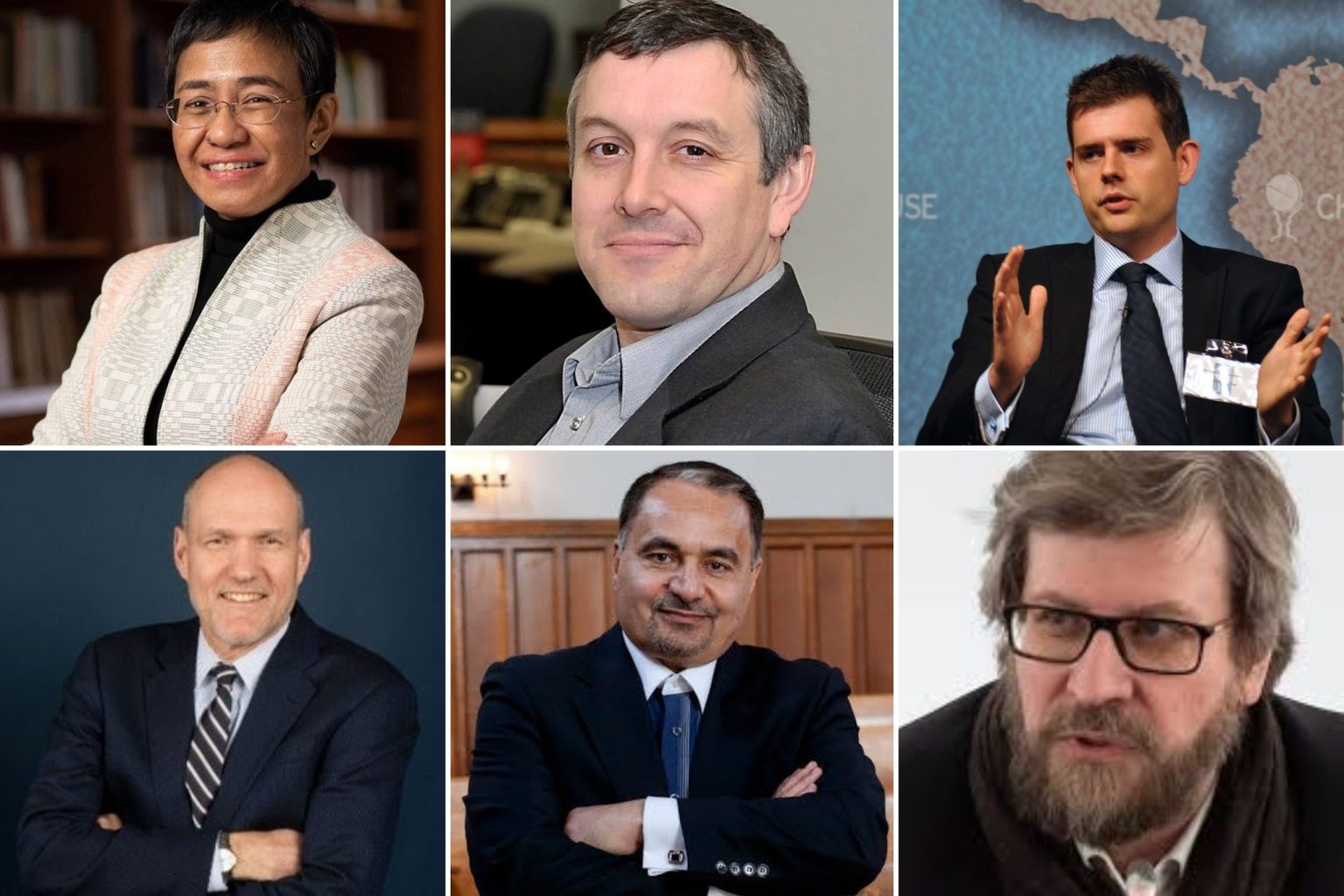
Pictured, clockwise: Maria Ressa, Colin Woodard, Matthew Goodwin, Stephen Walt, Seyed Hossein Mousavian, Fyodor Lukyanov
Several past and upcoming Camden Conference speakers have joined in the global conversation about the fast-approaching second US presidency of Donald Trump since his election Nov. 5. Among the more vocal has been upcoming 2025 “Democracy Under Threat” keynoter and 2020 speaker Maria Ressa. The 2021 Nobel Peace Prize winner and founder of the leading digital news site in the Philippines, Ressa told journalists at the International Center for Journalists in Washington: “Whether we can save democracy – or not – depends on you, what you do today. What we collectively do today matters.”
Speaking from Freeport, Maine, upcoming 2025 speaker, journalist, and best-selling historical writer, Colin Woodard, drew on colonial history to explain Trump’s election victory on Nova Scotian public affairs program CBCListen. Yet another 2025 speaker, Matt Goodwin, a professor of international politics and massively popular Substack blogger who first spoke at Camden’s 2018 “New World Disorder” conference, first termed Trump’s win “what happens when you ignore what millions of ordinary people have been saying for much of the last decade,” and later wrote about how the “populist revolt” is about to spread to Germany.
Belfer Professor of International Relations at Harvard, Stephen Walt – Camden’s 2018 keynote speaker – wrote in his Foreign Affairs column about “The Ten Foreign Policy Implications” of the election, starting with “Trump will be unpredictable” and “Liberal hegemony is dead,” and ending with a discussion of “Unified power in a divided society.” Non-subscribers to Foreign Affairs can find the article here.
Former Iranian nuclear negotiator and 2013 Camden Conference speaker Seyed Hossein Mousavian said in an interview with Al Arabiya English just after last month’s presidential election that Trump had made two “very constructive and positive statements” during his campaign. First, according to Mousavian, Trump said he is not after regime change in Iran, “which is very important.” And second, Trump said that he “just wants no nuclear bombs in Iran.” If these are Trump’s two main objectives, Mousavian added, and given that there’s a moderate government in Iran, there “could be a chance to make a new deal with Iran.” Mousavian is a Middle East security and nuclear policy specialist at Princeton.
Fyodor Lukyanov, editor of Camden’s 2015 Russia Resurgent conference and editor of Russia in Global Affairs, has written widely about prospects for Russian-US relations in light of Trump’s re-election. Emphasizing the possibility that Trump may succeed in his second term in breaking free of the US foreign-policy establishment’s cold war orientation in a way he did not before, Lukyanov is nonetheless cautious. However, he does note in general terms: “Another peculiarity of the president-elect is that even his detractors largely admit that he doesn’t see war as an acceptable tool. Yes, he’ll use hard bargaining, muscle-flexing and coercive pressure (as practiced in his usual business). But not destructive armed conflict, because that is irrational.”
In one of his other capacities, as research director of the Valdai International Discussion Club, Lukyanov moderated a lengthy Valdai Forum discussion with Russian President Vladimir Putin, covering a range of topics including the changing geopolitical system, artificial intelligence, climate change, and Russian-Chinese relations. Putin took questions and listened to statements by participants from not only Russia but also India, South Africa, Norway, China and Japan, among others. The discussion being just after the US election, Lukyanov himself asked Putin for his impression of the six different US presidents he had known and Trump in particular. After expressing admiration for Trump’s personal bravery in the face of assassination attempts, Putin said in reference to Trump’s first term: “I have the impression that he was hounded from all sides, that they would not let him do anything. He was afraid to take a step … I do not know what will happen now, I have no idea.” (This part about halfway through the transcript of the entire Valdai discussion).
Student Education Fund
Help ensure that future generations are informed and engaged on crucial global issues.