
Camden Conference Panel Offers Innovation, Cooperation and Optimism for Maine’s News Environment
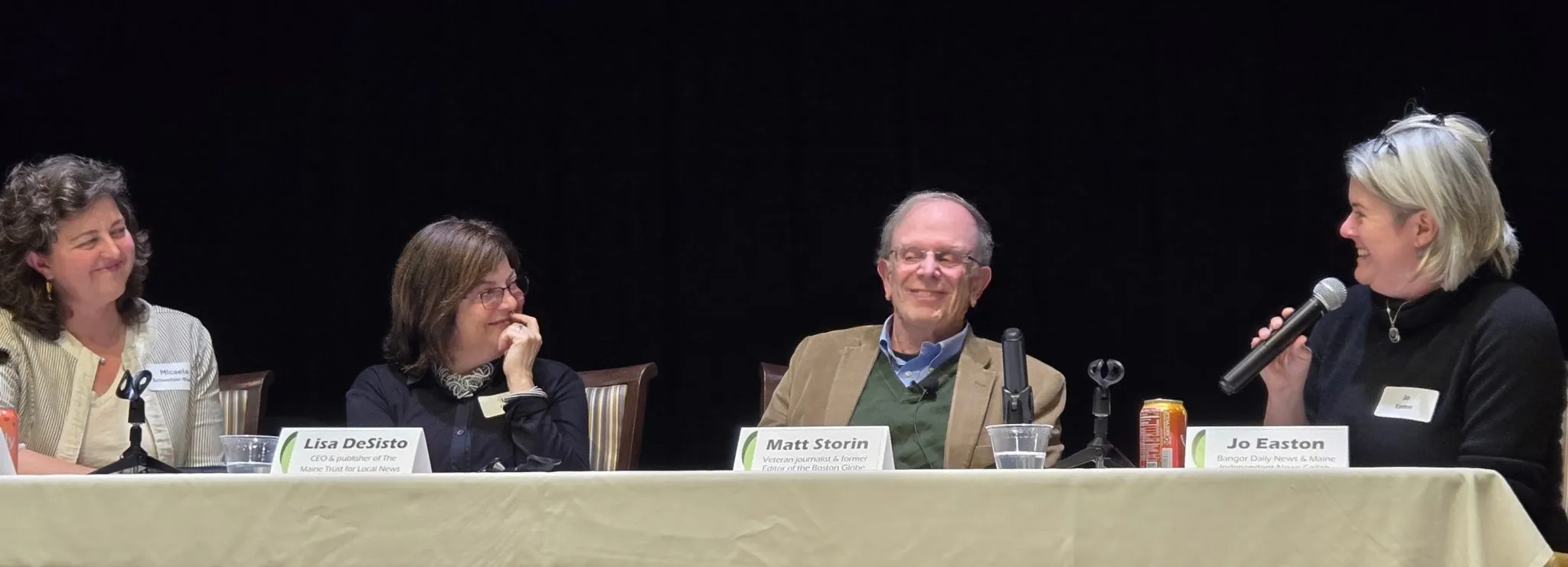
As legacy media, newspapers in particular, have shrunk in the Internet Age, local news coverage has been placed on the endangered list. Small town weeklies have folded and daily papers such as the Portland Press Herald and Bangor Daily News could no longer afford to cover the small towns. The resulting “news deserts” meant that the people’s business, being performed by zoning boards and town councils, was being done in darkness.
The panel discussion, “Democracy Diminished: Is Local News Dying?” was produced by the Camden Conference and hosted by OceanView at Falmouth in Lunt Auditorium, and featured Lisa DeSisto, CEO and publisher of the Maine Trust for Local News, Maine Monitor Executive Director Micaela Schweitzer-Bluhm, and Bangor Daily News Director of Development Jo Easton. The discussion was moderated by former Boston Globe editor Matt Storin, vice president of the Camden Conference, who noted that newspaper closures just in the last year around the country have left more than half of the nation’s 3,143 counties, or 55 million people, with just one or no local news source where they live. But the panel of Maine news media leaders offered hope for growth through new business models and statewide cooperation.
Lisa DeSisto said that since the arrival of the Internet, the biggest challenge to legacy media and especially print media has been declining ad revenue. The Portland Press Herald and a group of daily and weekly papers were sold in 2023 to the National Trust for Local News; the group re-branded to become the Maine Trust for Local News. While the papers still operate on a for-profit basis, the Maine Trust is a nonprofit organization, which allows the papers to seek grants and donations to augment ad revenues, which continue to decline. One trend that offers hope for the future, she said, is that Maine is attracting new talent. “So the good news is there are still lots of people coming out of college, great journalism schools that want to work at newspapers.”
The for-profit Bangor Daily News, the only Maine daily not owned by the Maine Trust for Local News, began in 2020 asking their readers for donations. At first, said Jo Easton, donors were told “we can’t give you any tax benefit, but this is our mission, and we need you,” said Jo Easton, “and people really responded.” That has since changed. “While we couldn’t provide a tax benefit in 2020, now we can through fiscal sponsorship.” While donations still count for a small portion of revenues, she said, “the number of donors and the amount of contributions has increased year over year.” But Easton felt that it’s time for news organizations to shift the narrative, “from the sky is falling, our business model is failing or has failed, or we’re talking about market failure. I don’t want to have that conversation all the time,” she said. “I want to talk about what is the value of local news. I want to talk about why local news is an important civic institution that we all need support. And I want to talk about how we go forward. And that is a challenge.”
Micaela Schweitzer-Bluhm said The Maine Monitor, which has been a nonprofit news organization since its founding 15 years ago, has seen increased philanthropic support for its news from both foundations and individuals. She also saw hopeful signs on Maine’s media landscape. “We’ve seen a lot of, in the last couple of years, really small, hyper-local news organizations that have popped up, independent, just trying to cover really local news. So there is growth.” She gave a shout-out to the Peaks Island News, an independent nonprofit bi-monthly that started up in 2023 on the Casco Bay island. She noted that a 2024 survey found that trust in national news was at about 37 percent, but when people were asked about local news, that goes up above 60 percent. “They believe their local news organizations more because they are local. They know the people producing the news,” she said. She added that The Maine Monitor is working to share its reporting not just through its free newsletters, but taking a multi-media approach, collaborating with radio and TV stations, including WERU, with which they produce The Maine Monitor Radio Hour, and Maine Public.
DeSisto seconded that idea, citing Skowhegan Now, a weekly digital newsletter that is written by an early-career journalist, Jake Freudberg, a reporter at the (Waterville) Morning Sentinel, owned by the Maine Trust for Local News. Freudberg’s beat is Skowhegan, “And he is crushing it,” DeSisto said. “He’s like a celebrity in Skowhegan.” The result of having Freudberg on the ground in Skowhegan for one year is that the Morning Sentinel’s penetration in that market has increased, she said. “So it just goes to show that when you are on the ground in the community, people will support you.”
Jo Easton said, “we should be in the business of supporting journalism, not supporting incumbent newspapers just because we exist. I mean, I want to keep my job. I want all of us to keep doing what we’re doing. But the point is supporting journalism that is good for Maine, that’s the end goal.”
Collaboration is the way forward, Schweitzer-Bluhm, commented, noting the cooperation between the news organizations on the panel and others throughout Maine, in order to deliver insightful news to Maine and to sustain a robust media landscape in Maine.
The video of the panel discussion is available here.
Student Education Fund
Help ensure that future generations are informed and engaged on crucial global issues.