
Camden Conference in the World (April 2026)
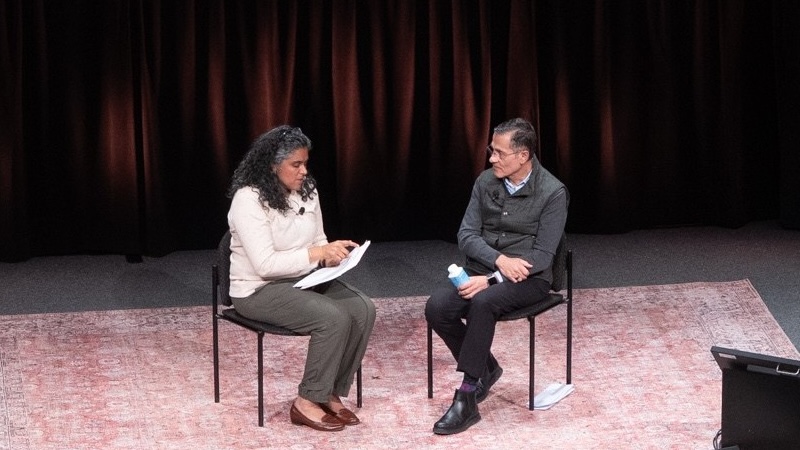
In the weeks since the US-Israeli war on Iran began on February 28, speakers from our 2026 Conference —Today’s Middle East: Power, Politics & Players— have been sought out by every major news organization. You don’t have to look far to find them!
Two voices already familiar to Camden audiences — Meghna Chakrabarti of WBUR’s On Point and Nick Schifrin of PBS’s Compass Points — have each hosted CC26 speakers Vali Nasr, Bernard Haykel, and Suzanne Maloney since the war began, building the most sustained broadcast record on the conflict in public media. Their episodes and links appear below with speakers they’ve featured.
Ethan Bronner has been reporting for Bloomberg from Israel throughout the war, offering an on-the-ground view of how Israelis are experiencing and understanding the conflict. His pieces have covered the surprising public calm — even triumphalism — in Tel Aviv in the war’s early days, the divergence between Israeli and American public opinion as the conflict has dragged on, the religious awakening among Israeli youth, and the UAE’s shifting alignment. On March 17, he presided at a Council on Foreign Relations conversation with UAE Presidential Adviser Anwar Gargash — a frank and revealing exchange about the Gulf states’ experience of Iranian strikes and what any settlement must guarantee. As recently as April 8, he was reporting on Israeli reaction to the tentative ceasefire and Netanyahu’s domestic political calculations.
Bernard Haykel has been one of the most sought-after voices on the war’s religious and geopolitical dimensions, appearing on Bloomberg, WBUR’s Here & Now, Channel 4 News, Middle East Eye, and twice on On Point with Meghna Chakrabarti. In a two-part April series, he traced the origins of Shia Islam, Khomeini’s patient consolidation of power after 1979, and the striking irony that the Islamic Republic has produced what may now be the most secular population in the Muslim world. His separate coverage of Gulf politics draws on his close relationship with Saudi Crown Prince Mohammed bin Salman, whose shifting posture toward the war he has tracked closely.
Joshua Landis shared his thoughts about the Iran conflict on a podcast with Robert Wright that was recorded the day after the Conference ended, and has since appeared on the Hidden Forces podcast, NPR, and BBC. His consistent thread has been skepticism about U.S. strategic clarity — arguing that the absence of a defined theory of victory risks repeating the pattern of open-ended regime-change wars the region has already lived through.
Suzanne Maloney has been one of the most clear-eyed and widely cited voices on the war, appearing on Nick Schifrin’s Compass Points, CNBC’s Squawk Box, The Ezra Klein Show, NPR, and Carnegie Endowment panels. Her major piece in Foreign Affairs — “The Third Islamic Republic” — argues that whatever emerges from this war will be a more hardened, emboldened regime. She was on NPR on April 8 assessing the tentative ceasefire, cautioning that Iran’s leadership will view it as a victory and that the underlying tensions are unlikely to stay quiet for long.
Vali Nasr has emerged as perhaps the most in-demand analyst of the war, appearing on NPR, CNN (with Christiane Amanpour), Bloomberg, Democracy Now!, WBUR’s On Point, and Nick Schifrin’s Compass Points on PBS. His central argument: Iran is fighting not for military victory but endurance, drawing on a “mosaic” strategy designed to outlast U.S. and Israeli air superiority. His book Iran’s Grand Strategy: A Political History, published last spring, provides the essential backstory. On April 7, he joined NPR to discuss U.S. strikes on Iran’s Kharg Island oil facility.
Robin Wright has been publishing steadily in The New Yorker since the war began, covering the killing of Supreme Leader Khamenei, the selection of his son as successor, and Trump’s contradictory posture toward Iran. In March, she wrote a personal editorial asking where the war is headed — reflecting on 53 years of reporting from Iran, and hosted a live Roundtable course titled “Iran in Crisis.” Few journalists have covered this country as long or as deeply.
And on a different note entirely:
David Brancaccio, a cherished Camden Conference moderator, has big news: after 13 years hosting Marketplace Morning Report he is stepping down from the daily host chair to take on a new role as Special Correspondent for Marketplace, reporting on long-term economic trends and the future effects of decisions being made now. His final week as host runs April 6-10. As he put it: “Let’s all agree, a key driver of so many bad money decisions at the personal, corporate and policy levels is short-term thinking. Let’s go long and see what we learn.” Congratulations, David — and we suspect his new beat will feel very familiar to Camden Conference audiences.
Student Education Fund
Help ensure that future generations are informed and engaged on crucial global issues.