
CC24 In the Press
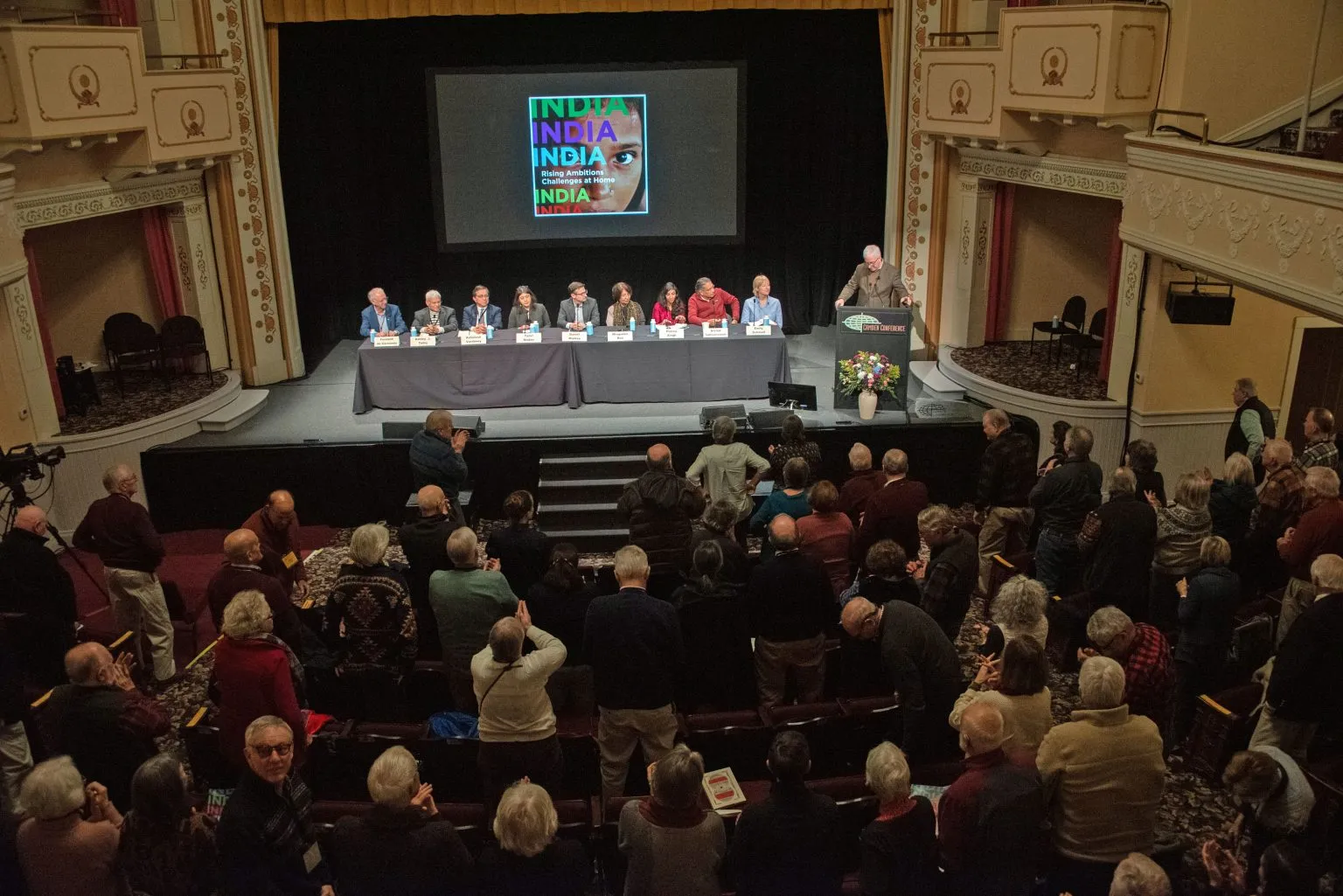
2024 Camden Conference ~ India – Rising Ambitions, Challenges at Home
The following Commentary by Ron Bancroft appeared in the Feb 22, 2024 edition of The Free Press
This year’s 37th Camden Conference was titled “India – Rising Ambitions, Challenges at Home”. Once again, the Conference’s timing was impeccable. India’s President, Narendra Modi, had recently been feted at a State Dinner in Washington, India had just passed China as the world’s most populous country. The long somnolent Indian economy was showing signs of growth. There seemed to be a new sense of possibility in much of India’s sentiment. Perhaps India, the world’s largest democracy, was poised to take “its rightful place” among the world’s powers. Or was it?
Such was the discussion among an unusually talented panel of speakers assembled in the Camden Opera House this past weekend. Our Saturday morning opened with a brilliant sketch of post-colonial Indian history and politics by Pratap Bhanu Mehta, Princeton history professor and Ashutosh Varshney, a Brown professor of Political Science. Mehta focused on the exceptionalism of the Indian experience, establishing a democracy based on Ghandi’s principles of non-violence with a robust, liberal constitution guaranteeing particularly freedom of religion and freedom of expression. India grew out of the traumatic partition of British India into a predominantly Hindu state (India) and a predominantly Muslim state (Pakistan). Even with partition, India remains with a large Muslim minority of more than two hundred million. It was therefore vitally important that India be established as a secular state with a Constitution enshrining religious freedom.
Professor Varshney and several of the speakers who followed raised concerns about the political path India has taken under the current Prime Minister. Modi and his party, the BJP, seems intent on defining India as a Hindu nationalist country, fanning the flames of grievance toward non-Hindus and moving away from many of the safeguards enshrined in India’s constitution. Increasingly Modi identifies himself as India, an India that is a Hindu nation. The recent ostentatious opening of a Hindu Temple to Lord Ram on the site of a former Islamic mosque was much cited as an example of Modi, who opened the temple personally amidst much press coverage, bulldozing Muslim sensitivities and extolling Hindu nationalism.
Emily Schmall, a New York Times correspondent, also described how Modi’s government is systematically cracking down on the press both foreign and domestic. Any criticism of the Prime Minister of the BJP is likely to bring repercussions, including imprisonment.
Nonetheless, Modi remains hugely popular. He is viewed by many as a leader who is raising India’s stature at home and abroad. India is facing national elections this spring and there is little doubt that the BJP will retain and likely expand their large majority in Parliament.
Meanwhile the Indian economy has gained momentum under Modi’s leadership. It appears that the manufacturing sector is finally beginning to draw significant foreign investment. The growth of GDP was up to 7% last year, well above the long-term trend of 2-3%. Still, like most of the issues in India, there is much to be concerned about. India has not invested significantly in health and education. For example, more than fifty percent of Indian women remain illiterate.
Throughout the Conference I was struck by the incredible contrasts in this country of 1.4 billion people. At the end of the Conference Moderator David Brancaccio asked each of the panelists for a single message to those of us attendees.
The panelists messages mirrored the contrasts of the world’s largest democracy. They talked about “spirit of renewal”, “journalism under threat but still vital”, “losing our exceptionalism”, “we are leveling the playing field in many areas, but I am worried about the increasingly nationalist policies”, “democracy heading toward something darker”, “fundamentalist nationalism usually doesn’t end well”, “India is aspirational – big challenges to meet them”.
In fact, the only thing all Conference speakers agreed about India was its passion for Cricket. Cricket is the national joy and obsession. India’s highly successful national cricket team is revered. Its players come from all castes and religions. It personifies what India so desperately hopes for its country- a significant and respected force on the world stage embodying the best of India’s kaleidoscope of people and religions.
Perhaps the best advice from the panelists was given by Prerna Singh, Brown Political Science Professor, who simply said “You must visit India and see for yourself.” My wife Sally and I have already started checking Overseas Adventure Travel to book a visit.
Ron Bancroft is a longtime Conference attendee and former Press Herald columnist, Cumberland.
Student Education Fund
Help ensure that future generations are informed and engaged on crucial global issues.