
PBS NewsHour’s Nick Schifrin draws large August crowd to the Camden Opera House
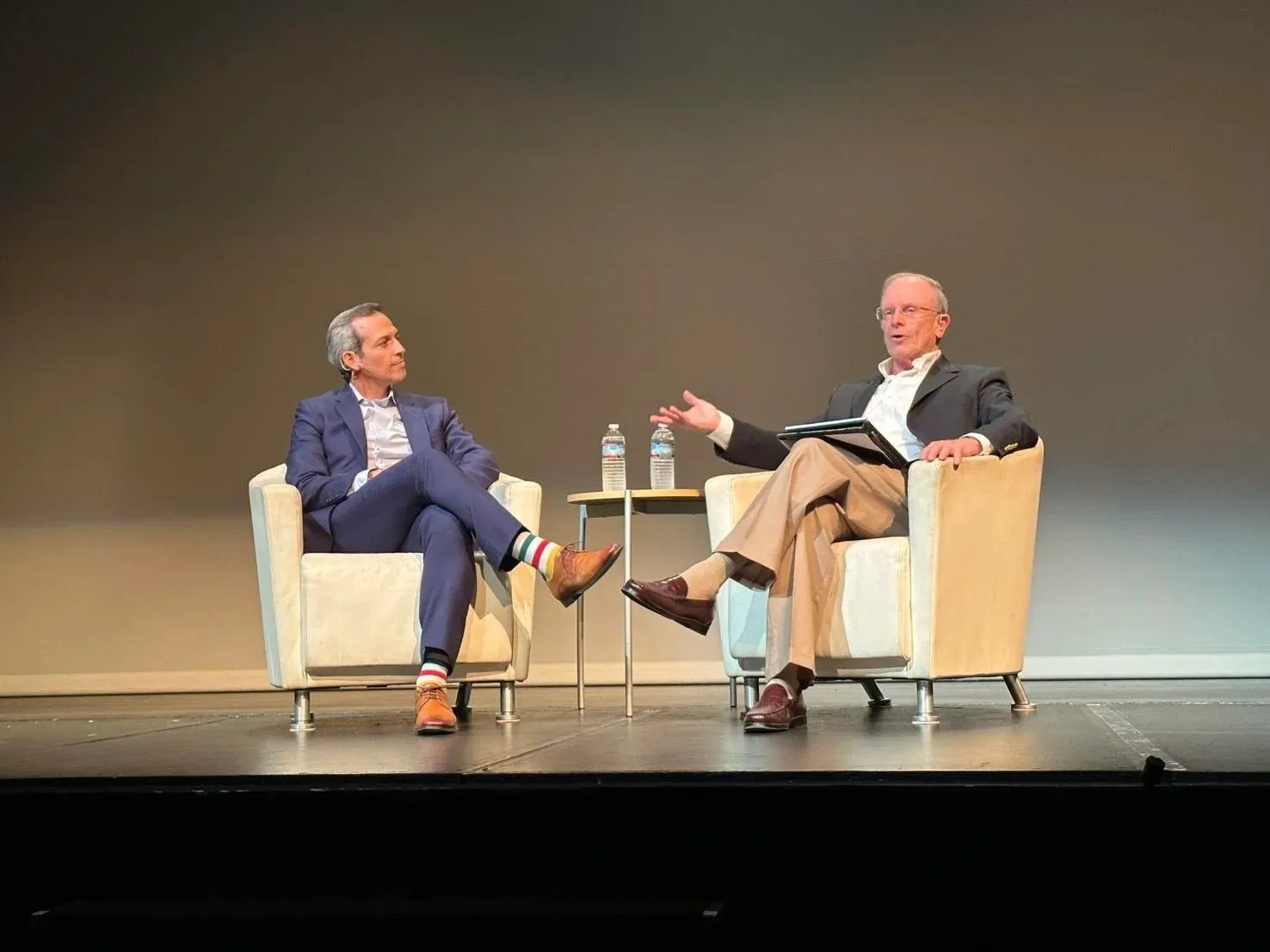
Nick Schifrin, left, speaks with Matt Storin at the Camden Opera House. Aug. 2024.
The following story by reporter, appeared in The Free Press on September 2, 2024 and is reprinted with permission.
The Camden Opera House was packed on Aug. 24 as journalist Nick Schifrin shared his experiences and insight gained from his years reporting overseas in war-torn territories. He is currently a correspondent for PBS News Hour’s Foreign Affairs and Defense and was formerly a Middle East correspondent for Al Jazeera. He has covered the war in Gaza for a decade.
As one of the first journalists on-site in Abbottabad, Pakistan, to cover Osama bin Laden’s death in 2011, he gave the world the first look into bin Laden’s compound.
It was Schifrin’s first visit to Maine, and Gov. Janet Mills was in attendance as Schifrin touched on global topics such as the war on Ukraine, Gaza and the upcoming U.S. presidential election. American journalist Matt Storin acted as moderator.
Early Days
Schifrin was a 21-year-old student in New York City when his world changed forever. On studying journalism he said, “I learned that my job was to ask anyone anything and go anywhere that I could physically reach and find stories … that deserve to be told. I loved that theory.”
On Sept. 11 of 2001, those theories became a reality for Schifrin.
He said, “I walked into my Shakespeare class at 8 a.m., and by the time I walked out, the world that existed when I walked in no longer existed.” He said he responded to the attack by taking the principles he had learned and applying them to his life.
“I was always interested [in journalism],” he said. “But I think anyone who’s covered these wars from my generation, that was the moment we all decided we had to understand why. And we had to go places to not only understand why, but to try and communicate why back to — in my case — America.”
Storin pointed out that, in his own journalistic experiences abroad, American troops had historically given journalists a measure of protection and safety. He asked Schifrin about his personal safety in Gaza and Ukraine, where American troops are not directly involved.
Schifrin shared a story of being within close range of a missile attack on an assignment and said, “I admit that I’ve been naive in thinking about how this kind of coverage would affect my family and myself. By extent, Gaza, Ukraine, Somalia, Iraq, whatever it is — they’re like merit badges on a war reporter’s sash. But they’re also scars that take a long time to heal, each. Leaving my 2-year-old son to go to Ukraine and talking to mothers whose 2-year-old sons have been killed … it’s hard.”
“None of us want to be the story; we all just want to tell the story,” he added.
Gaza
The war on Gaza is not limited to the 141-square-mile strip that has been bombed for the last 10 months; U.S. negotiations have been in the works between the Saudis and Israelis to reach an understanding, though Iran has also made pacts with the Saudis.
Storin asked Schifrin, “Is there any hope for any level of peace in our lifetime?”
Schifrin said, “There was once a study done on bias in journalism … the bias in American media is for peace. Meaning that we would cover stories in such a way that we would expect everyone to want peace … that is our bias as Americans. Sadly, it’s not looking good for peace. The question isn’t even anymore about peace. It is simply how to stop or pause a war.”
Schifrin said the war in Gaza is not about the Israelis and Palestinians, rather it is about power struggles between the Israelis and Arabs. An Israeli-Sunni-Arab alliance against Iranian threats was in discussion, and President Biden had summit conferences planned with multiple Middle Eastern leaders, which were disregarded after Oct. 7 of last year.
“The design [of that potential pact] creates a region in which, through military intelligence and diplomacy you isolate Iran and its threats,” Schifrin said.
Now, “A ceasefire is very unlikely,” he added. And though Iran cannot afford a war, economically or socially, Schifrin believes some future attack by Iran on Israel is likely.
One audience member asked Schifrin whether there were long-term plans to rebuild Gaza, especially since its health care and educational infrastructures have been destroyed.
Schifrin said, “Gazans have been through multiple wars, but nothing like this. I think it is an important story, but it goes to show the depth of their despair and the height of the crisis. It’s an impossible story to do, because you cannot ask a Gazan about tomorrow.”
Ethics and Empathy in Journalism
Throughout the evening, Schifrin was praised multiple times for his empathetic approach toward his interview subjects, as well as his succinct style of questioning his subjects, even beyond language barriers.
“I believe that while it would be an amazing thing to be able to live in a place where I spoke the language, I don’t believe that I need to,” he said. “In the process of meeting someone whose story I believe deserves to be told, I will try and communicate that empathy. Through that willingness to travel into their pain in conflict zones, I hope that they will understand that I am willing to expose myself to their pain, and therefore they feel comfortable sharing. I am not there for an adventure; I am there to share their story.
“People who see me willing to cry with them often will share.”
An audience member from Lewiston asked Schifrin about his reliance upon working with locals on foreign assignments, to which Schifrin replied, “I’ve lived in places for many years — Afghanistan, Pakistan, Israel — and I am alive thanks to my Afghan and Pakistani colleagues.” He credited story ideas, translation accuracy and editing to the people who acted as drivers, scouts, translators and more during his years living in conflict zones.
“I’m so grateful to have worked with those people,” he said. “You’re only as good as the person who understands the language, understands the country, and understands the story. You’re only as good as that person.”
Another audience member asked Schifrin about potential ethical or personal dilemmas he faced during his work.
Schifrin gave an example of an interview where he was speaking to the daughter of a deceased CIA operative whose life was surrounded by controversy. He said he had no intentions of asking the daughter something she not only was not qualified to answer, but that might cause emotional distress.
“There are questions that I go through in my mind every day when it comes to an interview that has to do with grief,” he said. “Inviting someone to share rather than forcing them to relive — that’s a real psychological difference. I think that’s the biggest dilemma that I face. More geo-politically, some of the reporting we do is fraught; talking about Israel and Gaza, let’s just say I am the target of a lot of hate online from both sides.”
Schifrin was hosted by The Camden Conference, as part of its Democracy Under Threat: A Global Perspective series running through February of 2025. For more information on The Camden Conference’s geo-political lectures and events, visit camdenconference.org.
“An Evening with Nick Schifrin” may be viewed HERE. Maine Public served as a media sponsor of this Camden Conference presentation.
Student Education Fund
Help ensure that future generations are informed and engaged on crucial global issues.