
A Student’s Perspective on the 2026 Camden Conference
BY TYLER LISSY
The 2026 Camden Conference was a unique blend of complexity and clarity. It provided thoughtful and compelling analysis of a region that is both well-known and misunderstood, offering nuanced ideas and insights into the Middle East and leaving us with as many questions as answers – a worthwhile and thought-provoking result.
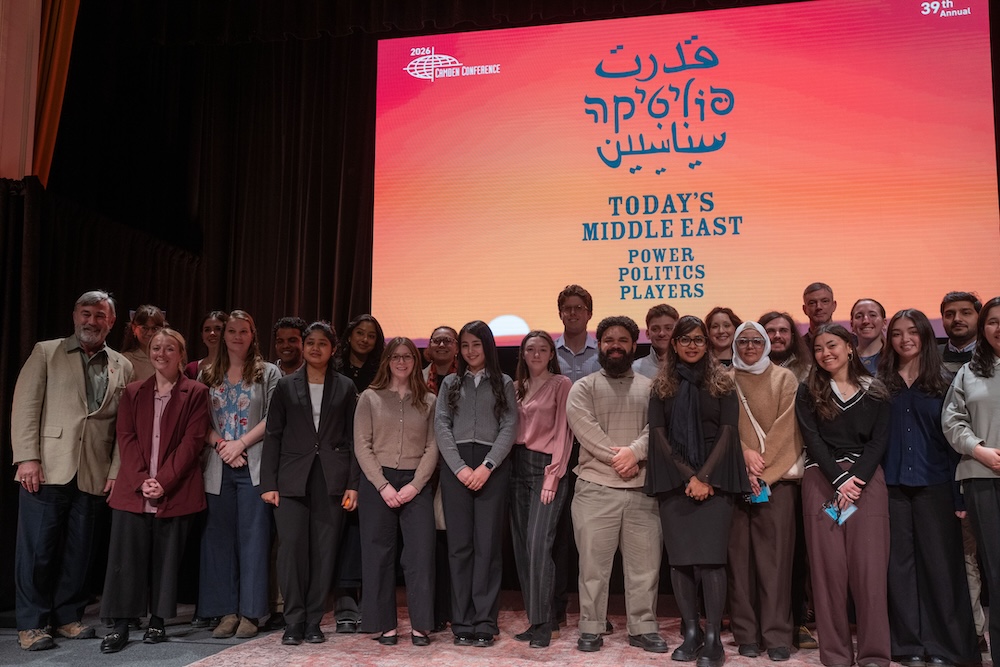
I am a graduate student at the University of Maine’s School of Policy and International Affairs (SPIA), where I concentrate on security and foreign policy. The Camden Conference has become a staple event for our graduate program, and my graduate school funds this excursion for SPIA students interested in attending. I have never traveled to the Middle East but as an undergrad I studied the international politics of the region. That mix of familiarity and distance shaped my Conference experience.
The subtitle, Power, Politics, and Players, proved apt. But as I listened across three days of presentations, I noticed several deeper dynamics weaving through the conversations. Three stood out to me: the tension between complicated and compressed histories; the distinction between power and threat; and the challenge of perceiving the region with objectivity rather than insensitivity.
Speaker after speaker reminded us that the Middle East cannot be understood without grappling with its deeply complicated, layered past. Joshua Landis emphasized the fragility of nation-building projects born from imperial sorting processes, where states were told to “get along” within borders shaped by external powers. Regime change, he suggested, does not necessarily produce stronger states; even weak institutions are not easily replaced.
History is frequently shaped by outside powers, media cycles, and homegrown leaders. Suzy Hansen argued that labeling Tayyip Erdoğan simply as a populist risks downplaying the socioeconomic and religious currents that propelled his rise. When major powers engage the region transactionally, such as the initiation of the Abraham Accords, historical nuance can be sacrificed for immediate interests. I was struck by how often simplified narratives obscure the very dynamics policymakers most need to understand.
Several speakers implicitly reviewed whether regional behavior is better explained by the pursuit of power or by the prominence of threat. Bernard Haykel described Saudi Arabia under Mohammed bin Salman as a state seeking stability yet still grappling with questions of national identity beyond its religious custodianship. Vali Nasr argued in his keynote that the post-Gaza war Middle East has been transformed by collapsing axes of resistance and shifting power vacuums. His analysis suggested that threats often substantiate power, rather than merely challenging it.
This dynamic was also evident in discussions of Israel. Ethan Bronner described a country navigating the tension between pariah and regional superpower, where perceptions of existential threat shape government doctrine and public sentiment. Omar Dajani, a Palestinian, urged consideration of bridge-building approaches, unpacking the importance of a durable peace rather than the overemphasis of threat. I found myself wondering whether stability in the region hinges more on balances of power or balances of threat, and how much balance depends on perception.
Robin Wright’s visual presentation reminded the audience of the human dimension behind geopolitical abstractions, while Stephanie Williams highlighted the region’s stateless peoples (Kurds, Palestinians, and others), describing them as victims of geography and history. Their stories underscored how neat national borders can produce enduring instability.
I left Camden with several open-ended questions. How much have rigid national borders contributed to the very instability they were meant to prevent? As international politics grows more transactional, do major powers further compress regional histories to fit short-term interests, ironically undermining their own long-term goals?
More broadly, if the post-World War II rules-based system has helped prevent direct great-power war, what does it mean that today’s conflicts so often operate in gray zones – proxy wars, hybrid tactics, ambiguous thresholds? If rules are increasingly treated as pliable, does that normalize forms of conflict that are less visible but no less destabilizing?
What I appreciated most about the Camden Conference was not that it resolved these dilemmas, but that it took them seriously. For students like me, the conference offered something invaluable: exposure to expertise that refuses easy answers. The Middle East cannot be reduced to headlines, but is a region where power and threat intertwine, where history is both burden and guide, and where human dignity persists amid upheaval.
Students rely on experts not only for information but for intellectual example, and that may be the most important lesson of all. Maybe an alternative lesson is what we students have to offer to such experts, leveraging optimism, not cynicism, to generate nuanced analysis and legitimate pathways forward.
Education | News | Recent-News
Student Education Fund
Help ensure that future generations are informed and engaged on crucial global issues.