
Home > News > Recent-News >
Camden Conference in the World (November 2026)
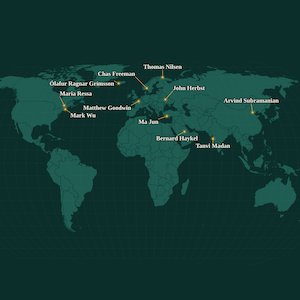
A snapshot of what former speakers have been up to recently:
John Herbst (CC22) — The Atlantic Council’s Eurasia Center senior director and former U.S. ambassador to Ukraine argues in a new dispatch that the administration’s recent moves, including a diesel deal with Vladimir Putin and a waiver of Russia sanctions, have tilted toward Moscow, even as envoy Steve Witkoff’s trips to Oslo and Moscow hint at a possible change of course. Given the administration’s back-and-forth approach, Herbst writes, pressure from Congress and the American public will be needed to push it toward a tougher stance against Russian aggression.
Chas Freeman (CC11, CC18) — Former assistant secretary of defense and ambassador to Saudi Arabia Chas Freeman, our 2011 keynote speaker, joined Glenn Diesen for a 52-minute conversation titled “European Leaders Are Sabotaging Peace Yet Again.” Freeman said the Oslo proposal for Ukraine was never likely to interest Moscow, since the NATO members who drafted it refused to talk with Russia at all, and he called a rival plan from economist Jeffrey Sachs, built around Ukrainian neutrality, no foreign troops and demilitarized buffer zones, a more realistic basis for negotiation. He argued that Russia now expects to settle matters on the battlefield, and that Europe’s refusal to discuss a wider security architecture leaves it on the sidelines. Turning to the Middle East, he saw no real diplomacy on Iran and described new regional security groupings as an effort at strategic autonomy from Washington. He also lamented what he called the politicization of American diplomacy and the rise of populism across Europe, closing with, “I wish I had something positive to say.”
Bernard Haykel (CC26) — Princeton professor Bernard Haykel, a speaker at our 2026 conference on the Middle East, appeared on CNN’s Fareed Zakaria GPS on October 17 to discuss why the Houthis have been so effective militarily against Saudi Arabia, largely through ballistic and cruise missiles. “The Saudi military was designed for a different kind of war — a more traditional invasion, such as Iraq or Kuwait,” he told Zakaria. Haykel also noted that the kingdom’s armed forces were deliberately kept weak in years past as a safeguard against coups targeting the royal leadership. He predicted the Houthi threat will persist, and that Saudi Arabia’s only real way to contain it is to buy them off. Watch the interview.
Ólafur Ragnar Grímsson (CC21) — Camden Conference Executive Director Kimberly Scott joined the official Maine delegation to the 2026 Arctic Circle Assembly in Reykjavík, Iceland, last month. While there, she reconnected with Ólafur Ragnar Grímsson, former President of Iceland and founder and chairman of the Arctic Circle, and the two reminisced about his outstanding keynote at our 2021 Conference, The Geopolitics of the Arctic: A Region in Peril. Kim’s attendance at earlier Arctic Circle Assemblies provided many of the ideas and contacts that shaped that 2021 Conference. Grímsson also sat down with Ayla Majid, founder and CEO of Planetive, for an EU Reporter interview on resilience in an unpredictable world. True resilience, he says, is the capacity not just to endure a shock but to learn and adapt, and it has to be built through education, social cohesion and open debate long before a crisis arrives. He urged leaders to invest in cooperation before crisis forces it, adding that “dialogue is not weakness.”
Thomas Nilsen (CC21) — The editor of The Barents Observer is in the news twice this month. Columbia Journalism Review profiled his newsroom in Kirkenes, Norway, just nine miles from the Russian border, as a haven for exiled Russian journalists. And in his own report for the Observer, Nilsen describes Norwegian and British F-35s escorting a U.S. B-52 over the Norwegian Sea ahead of the U.S. Strategic Command’s Global Thunder exercise, even as President Trump disparaged Norway at a rally in Michigan.
Arvind Subramanian (CC24) — The former chief economic adviser to India’s government and Peterson Institute senior fellow co-wrote a Project Syndicate commentary, “Is a Chinese implosion looming?”, with energy economist Navneeraj Sharma. They warn of a possible perfect storm in China: a disorderly succession, a slowing economy, and a shrinking tax base, with tax revenue (excluding social-insurance contributions) falling from 18.4 percent of GDP in 2012 to 12.6 percent in 2025. A slow bleed is likelier than a sudden collapse, they write, but even that could become another global shock.
Ma Jun (CC19) — Ahead of the COP31 climate summit in Antalya, Turkey, November 9–20, Ma Jun, director of Beijing’s Institute of Public and Environmental Affairs, told the state-run Global Times that the gap between emissions pledges and real action remains wide and that geopolitical divisions are hampering climate cooperation. He said China’s approach of linking emissions cuts with pollution control, clean energy, and green job creation offers lessons for other developing countries, which could be shared through South-South cooperation.
Mark Wu (CC23) — Harvard Law School’s Henry L. Stimson Professor joined a Harvard panel on sanctions and economic coercion. Wu cautioned that economic tools may not deliver the results that Cold War experience led people to expect, and questioned whether middle and lower-income countries forging new trade ties could afford to emerge as a credible third pole alongside the U.S. and China. Fellow panelists warned that heavy use of coercive tools gives other countries an incentive to build alternatives to the U.S. financial system.
Tanvi Madan (CC24) — The Brookings Institution senior fellow reads Secretary of State Marco Rubio’s quick second visit to India as evidence that, despite frictions, the Trump administration sees India as useful to several of its interests. In a Hindustan Times column, “Decoding Rubio’s quick second visit to India,” Madan points first to energy, with India as both a major consumer and a refined-products exporter, and to a possible shift toward Indian purchases of Venezuelan oil. She also sees the economic and political dimensions in Rubio’s meetings with Indian business leaders and his remark that a trade deal is “incredibly close,” with possible Modi–Trump meetings in November and December as action-forcing events. Security cooperation was less front and center, though Rubio praised the Quad. Both sides acknowledged differences, among them U.S. policy toward Pakistan and immigration, and Madan concludes that whether they can be managed will set the ceiling for the relationship.
Matthew Goodwin (CC18) — The University of Kent politics professor took up the prospect of a President Marine Le Pen in a clip from his weekly Substack Live, amid riots in France and the latest polling, and weighed what it could mean for Britain.
Maria Ressa (CC20, CC25) — The Nobel Peace Prize laureate, our 2025 keynote speaker, has been busy this month. At the WINGS philanthropy forum in Montreal, she warned that unchecked AI threatens human autonomy, democracy, and public safety. And on October 27 she delivered the keynote at a UNESCO and UN Women event at UN headquarters on women journalists in conflict zones.
Student Education Fund
Help ensure that future generations are informed and engaged on crucial global issues.