
Home > News > CC In the World >
Camden Conference in the World ~ February
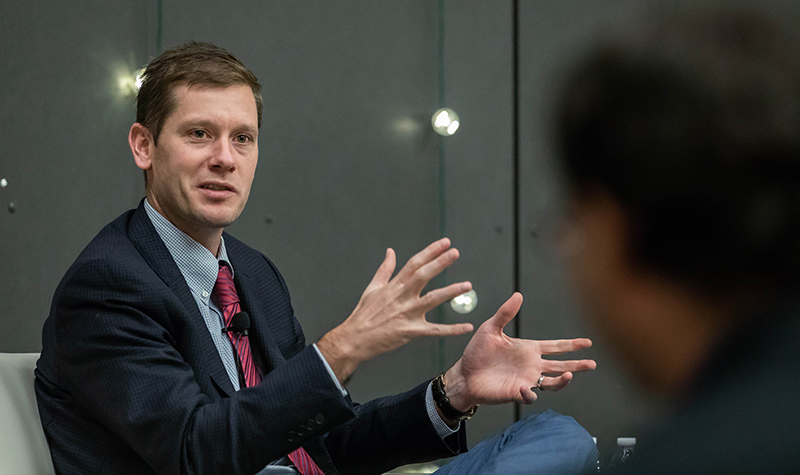
The speakers who will provide such a fascinating mix of viewpoints and expertise on the Opera House stage at February’s Democracy Under Threat: A Global Perspective 2025 Camden Conference were in prominent display on the global online stage in January.
Johns Hopkin’s School of Advanced International Studies professor, American Enterprise Institute Scholar, and Bloomberg columnist Hal Brands, pictured above, argued that concern about the health of our own democracy should not deter an active US posture in defense of democracy on the international stage. “Other countries are not going to call a timeout in terms of global competition if the US withdraws to focus on its own internal imperfections. And so if we are geopolitically paralyzed by the weaknesses in our democracy, then the world will be shaped by powers that are less inclined to introspection, and that ultimately will not be a good thing for democracy in the United States or in a lot of places around the world.” This rousing statement concluded a discussion in late January between Brands and Council on Foreign Relations Distinguished Senior Fellow James Lindsay that focused on Brands’ recent book The Eurasian Century: Hot Wars, Cold Wars, and the Making of the Modern World.
Instead of looking outward like Brands, best-selling author, expert on US regionalism and nationalism, and sometime Mainer Colin Woodard looked inward in a Washington Monthly analysis of a disorientingly “pedestrian” 2024 election in which “Democracy was on the ballot, but many voters made the election about the price of eggs.”
Another speaker at the upcoming (not to mention the 2018) conference, UK political science academic and author of Britain’s second-Substack blog Matt Goodwin, reported on that blog about his pre-inauguration adventures in Washington, including a meeting with Trump “consiglieri” Steve Bannon, and the “real sense among Europe’s rebels and disruptors that with Donald Trump’s re-election the wind is now firmly behind their sails.”
Equally diverse voices of past Camden Conference speakers were heard and seen online last month. Cleo Paskal, who appeared on the Camden Opera House stage along with Goodwin in 2018, attended and reported on a presidential inauguration last month that was very different from the one in Washington: That of Surangel S. Whipps Jr. as president of the tiny but geopolitically strategic Pacific nation of Palau. Find out who came to that party and why it matters.
Both 2019 China conference speaker Kaiser Kuo and his 2022 Europe conference counterpart Mark Leonard skipped the inauguration scene altogether in favor of attending and reporting on the activities of the global elites gathered in Davos for the 2025 World Economic Forum. Kuo focused on China. Leonard noted how “Trump’s return to the White House marks the start of an anti-Davos age” and the beginning of a “polycentric world.”
Two-time Camden Conference speaker and Hoover Institution stalwart Elizabeth Economy pushed in Foreign Affairs last month for President Trump to let the US use against China “the biggest weapon in its (economic) arsenal: trade agreements.” Largely ignoring Trump’s long-standing contempt for trade deals, Economy and co-author Melanie Hart, senior director of the Atlantic Council’s Global China Hub, outlined how a shared policy across the first Trump and the Biden administrations of “de-risking” supply chains by avoiding Chinese inputs has been helpful, but not enough. Tariffs, too, are “only one tool in a much larger toolkit.”
Amory Lovins, founder of Rocky Mountain Institute (RMI) and 2014 Food and Water conference speaker in Camden, in an essay written “on the eve of a major US political transition,” returned to the principal of “applied hope” used to guide his founding of RMI 40 years ago. He still sees applied hope as a valid guide for not only RMI but also for people in their daily lives at this juncture in history. “This is not a dress rehearsal,” he writes. “This is the real thing, our moment onstage, and humanity has — we have — just one chance to get it right. We humans are the first self-endangered species. Let us not be the last.”
Student Education Fund
Help ensure that future generations are informed and engaged on crucial global issues.