
Camden Conference in the World (September 2026)
True to form, alumni speakers from the Camden Conference remained in the news last month.
The steady erosion of the U.S.-led world order has been a preoccupation of Mark Leonard, director of the European Council on Foreign Relations and a speaker at Camden’s 2022 Conference, Europe: Challenged at Home and Abroad. In a new Foreign Affairs essay titled “The Abandoned Order,” Leonard argues that the rules-based system that has governed world affairs for 80 years is unraveling, accelerated by a second Trump term that has walked away from international institutions and rattled longtime allies. He unpacked the argument, and his advice to world leaders navigating the shift, in an NPR interview.
Maria Ressa, the Nobel Peace Prize–winning journalist who delivered the keynote address at Camden’s 2025 Conference, Democracy Under Threat: A Global Perspective, is turning her attention to a new front in the fight for truth online. In a profile in the Australian Financial Review, Ressa discusses her crusade against the flood of low-quality, often AI-generated content — “slop” — that she argues is degrading public discourse and making disinformation harder to spot and combat.
Two speakers from Camden’s 2019 Conference, Is This China’s Century?, have been weighing in on China’s trajectory. Keynote speaker Martin Jacques, author of When China Rules the World, joined a CGTN panel debating whether China’s advances in AI, robotics, and biotech amount to a “China Shock 2.0” — or an opportunity. His framing of China as a “civilization-state,” whose identity precedes its statehood, also anchored a Global Policy Journal essay on how badly Washington has misjudged Beijing’s rise. Meanwhile, Johns Hopkins political economist Yuen Yuen Ang, in an interview with the World Peace Foundation, unpacked “polytunity” — her reframing of today’s global disorder not as crisis but as a rare opening to rebuild institutions more inclusively, with a greater voice for the global majority in shaping a multipolar order.
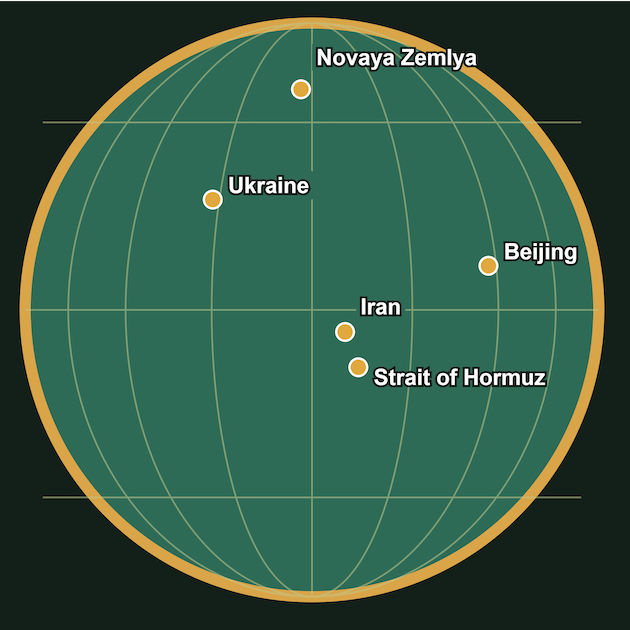
Thomas Nilsen, editor of The Barents Observer and a speaker at Camden’s 2021 Conference, The Geopolitics of the Arctic, continues his close coverage of Arctic security. In a recent dispatch, Nilsen reported on Russia’s preparations for a new round of tests of its nuclear-powered Burevestnik cruise missile near Novaya Zemlya, citing satellite imagery showing specialized radiation-monitoring aircraft moving into position.
Simon Evenett, Professor of Geopolitics and Strategy at Switzerland’s International Institute for Management Development (IMD) and a speaker at Camden’s 2023 Conference, Global Trade and Politics: Managing Turbulence, spoke on a Peterson Institute panel about the Strait of Hormuz closure. In an essay for IMD, Evenett argued the crisis is reshaping how executives think about supply chains, pushing companies toward new trade routes and prompting governments to weigh continuity of supply as seriously as tariffs.
Stephen M. Walt, Professor of International Affairs at Harvard’s Kennedy School and keynote speaker at Camden’s 2018 Conference, New World Disorder and America’s Future, sat down for a wide-ranging, hour-plus interview with Tucker Carlson. Walt argued the world emerging from the wars in Iran and Ukraine will be more dangerous and more tripolar, with the U.S., Russia, and China as the three main powers, and warned that eroding global norms and America’s damaged credibility will outlast the conflicts themselves.
Two speakers from Camden’s 2023 Conference, Global Trade and Politics: Managing Turbulence, have been examining the fallout from the latest round of tariffs. Georgetown Law’s Jennifer Hillman, writing with fellow trade scholar Peter Harrell in Reason magazine, laid out the legal vulnerabilities in the Trump administration’s new Section 338 tariffs on Canada, a Depression-era statute never before used to impose duties, arguing the tariffs sweep far beyond the trade disputes they claim to address. And Caroline Freund, dean of the UC San Diego School of Global Policy and Strategy, found in new research that foreign exporters absorbed 40 to 50 percent of last year’s tariff increases by cutting their own prices, far more than earlier studies assumed, helping explain why consumer prices have risen less than headline tariff rates might suggest.
Cleo Paskal, Indo-Pacific researcher and a speaker at Camden’s 2018 Conference, New World Disorder and America’s Future, joined a Bureau podcast investigation into China’s growing influence across the Pacific islands linking Hawaii to the first island chain, from a troubled Saipan casino venture to a bribery case in the Marshall Islands, arguing that Beijing understands the strategic value of this American corridor better than Washington does.
Student Education Fund
Help ensure that future generations are informed and engaged on crucial global issues.