
Home > News > Recent-News >
2026 Camden Conference – Ron Bancroft’s Recap
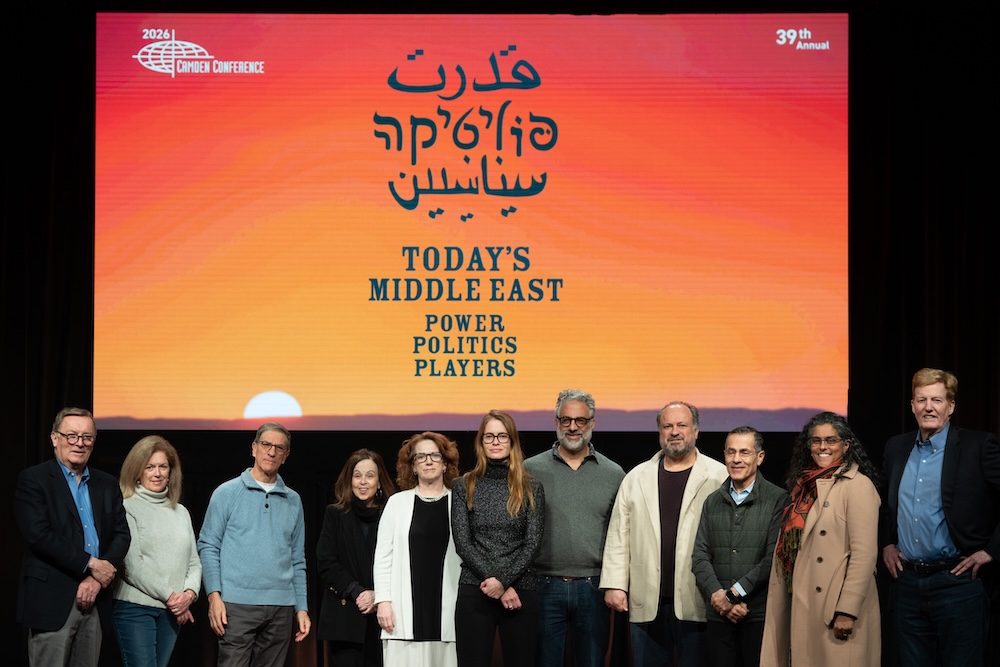
Academics, foreign service veterans, journalists, and engaged citizens from far and wide descended on Camden for the 39th Camden Conference last weekend [Feb 20-22, 2026]. This year’s topic, “Today’s Middle East: Power, Politics, & Players,” marked the fourth time the Conference has tackled the Middle East, a Conference record that reflects the seemingly intractable issues that have plagued this region in the eighty years since the end of World War II.
Unfortunately, recent developments in the Middle East have left the region more unstable and more inflammatory than the world has seen in many years. The fissures were made clear in the keynote address on Friday evening by Vali Nasr, Professor of International Affairs and Middle East Studies at Johns Hopkins University.
Professor Nasr chronicled the series of events triggered by Hamas’s surprise attack on Israel on October 7th, 2023 in which more than twelve hundred Israelis were murdered. Israel responded. The devastation in Gaza was immense, triggering an unparalleled humanitarian crisis. And Israel did not stop with Gaza. Indeed, it decided it must also address the threats posed by Hezbollah and other proxies of Iran. It was extraordinarily successful in taking out many levels of leadership and essentially sidelining Hezbollah. Then came the Twelve-Day war with Iran itself in which Israel dealt a severe blow to Iran’s nuclear capacity. The effect of this unleashing of Israeli power, according to Nasr, is that Israel has toppled the balance of power in the Middle East and is now the hegemon of the region. Because the United States has shown no appetite for curbing Israel, indeed the U.S. participated briefly in the 12-day war, Israel was emboldened to extend its military forces into Lebanon and Syria.
This then was the setting, a Middle East landscape shaken to its core, as we began to delve into the details. Opening on Saturday, Joshua Landis, Professor of Middle East Studies at the University of Oklahoma, led us in a highly engaging tour of the post-war history of the region, marked by the transition from empires to nation states, most of which ended up being headed by leaders of ethnic minorities such as the Alawites in Syria and Saddam Hussein in Iraq. Many of these regimes were fragile, tended to autocracy, and contributed to the instability of the region.
Professor Landis was paired with Robin Wright, the veteran journalist of the region who, through the lens of her camera, showed us the real people behind the stories seen in elegance, in squalor, and simply on the street. She brought the human touch to this many faceted region.
We also learned more of the major players in the region: Saudi Arabia, Turkey, and Iran. Bernard Haykel, Professor of Near Eastern Studies at Princeton University, discussed the evolution of Saudi Arabia under the leadership of Mohammed bin Salman (MBS). MBS has committed himself to transforming Saudi Arabia from its dependence on oil revenues through a series of mega projects in alternative energies. Incredibly costly and incredibly risky, this inward focus has meant that Saudi Arabia has been less inclined to push its political influence in the region.
On the other hand, Turkey under President Recep Tayyip Erdogan is determined to counter Israel’s outsize role in the region. Suzy Hansen, a journalist who has spent many years in Turkey, reminded us that he has been successful in both shaping a prosperous country and consolidating power in anti-democratic ways. Erdogan’s willingness to accept substantial numbers of refugees has given him leverage with other countries in the EU.
Lastly, Suzanne Maloney, Vice President and Director of the Foreign Policy program at the Brookings Institution, brought us up to date on Iran’s situation, which is, in a word, dire. She is convinced that the regime is failing. They have bought short term stability by crushing protest. However, the economy is faltering, Iran’s regional power has been quashed by Israel, and the United States is threatening military pressure. Chaos in Iran, a country with ballistic missiles and nuclear capability, is more than a regional issue
We wrapped up the day on Saturday by taking a look at Israel and Palestinian perspectives on the current situation. The Israeli perspective came from Ethan Bronner, the Israeli Bureau Chief of Bloomberg News. His take on Israel is that, in spite of extremists ascendant on both sides, there is a booming economy fueled by tech centers and innovation. There is also Settler violence. There is no appetite for a Palestinian state. There is little interest in collaboration.
On the other hand, the Palestinian perspective came from Omar Dajani, Professor of International Law at the University of the Pacific. Professor Dajani is working with a group of moderate Palestinians and Israelis to find common ground. This group is trying to re-envision the relationship between Israelis and Palestinians from two sovereign states to one state where all co-existed, separate but with equal rights and equal economic opportunity.
Professor Dajani recognizes that many will see this approach as impossible and Pollyannaish, but he is in this for the long term. He also realizes they will get nowhere without significant internal support. At the moment this is likely a bridge too far, but I admire what Dajani’s group is willing to take on.
To pull together the strands of the many geographies we had discussed, Stephanie Williams, Senior Fellow at the Brookings Institution’s Center for Middle East Policy, discussed the stateless peoples of the Middle East, focusing on the two largest of these groups, the Kurds and the Palestinians. Kurds number between 30 to 45 million worldwide with most in Turkey, Iraq, Iran, and Syria. In spite of their large numbers and substantial position in many states, the Kurds do not seem to get the attention they deserve. There was a Kurdish woman at the Conference who, on several occasions, asked plaintively “Why are we forgotten”. It is another of the region’s seemingly unanswerable questions tied up in history and too many national politics. Ms. Williams talked about codifying rights and granting autonomy, but made it clear such actions would be difficult to pull off.
On the issue of Palestinians, she noted several million had already been absorbed in the West Bank, in Jordan, and in Lebanon. Left unsaid was the question of how to deal with a likely new flood of refugees from the West Bank as Israel expands its settlements.
How does one wrap up the complex set of issues and players that is the Middle East? Obviously, one turns to a veteran foreign service pro to tease out the broader implications of the current situation. Jeffrey Feltman is a Visiting Fellow in International Diplomacy at the Brookings Institution and a former UN Under-Secretary-General for Political Affairs. Ambassador Feltman both in his prepared remarks and subsequent panel discussion, painted a grim picture of the Trump Administration’s unraveling of the eighty years of US leadership in developing a largely successful world order. He noted significant issues not being addressed by the Trump administration, e.g. what does deterrence mean in an era with few limits on weaponry, and what are the military implications of AI. He called on the “Middle Powers” to step up to leadership roles and he ended with a plea for “restraint and cooperation”, noting that these were not signs of weakness.
It was left to Conference Moderator Meghna Chakrabati, from NPR’s On Point, to pry some hope from the panel of speakers. There were few good examples. Perhaps the most representative was a paraphrase from writer Jill Lepore, “Let’s not talk of hope, talk of determination”.
All in all, though there are glimmers of hope, the Middle East seems to be poised to move toward rewarding force rather than rewarding “restraint and collaboration”. This is unfortunate for the Palestinians, the Kurds, and the world.
Ronald M. Bancroft of Union is a long time Conference attendee and former weekly columnist for Portland Press Herald.
Student Education Fund
Help ensure that future generations are informed and engaged on crucial global issues.