
Camden Conference in the World (October 2026)
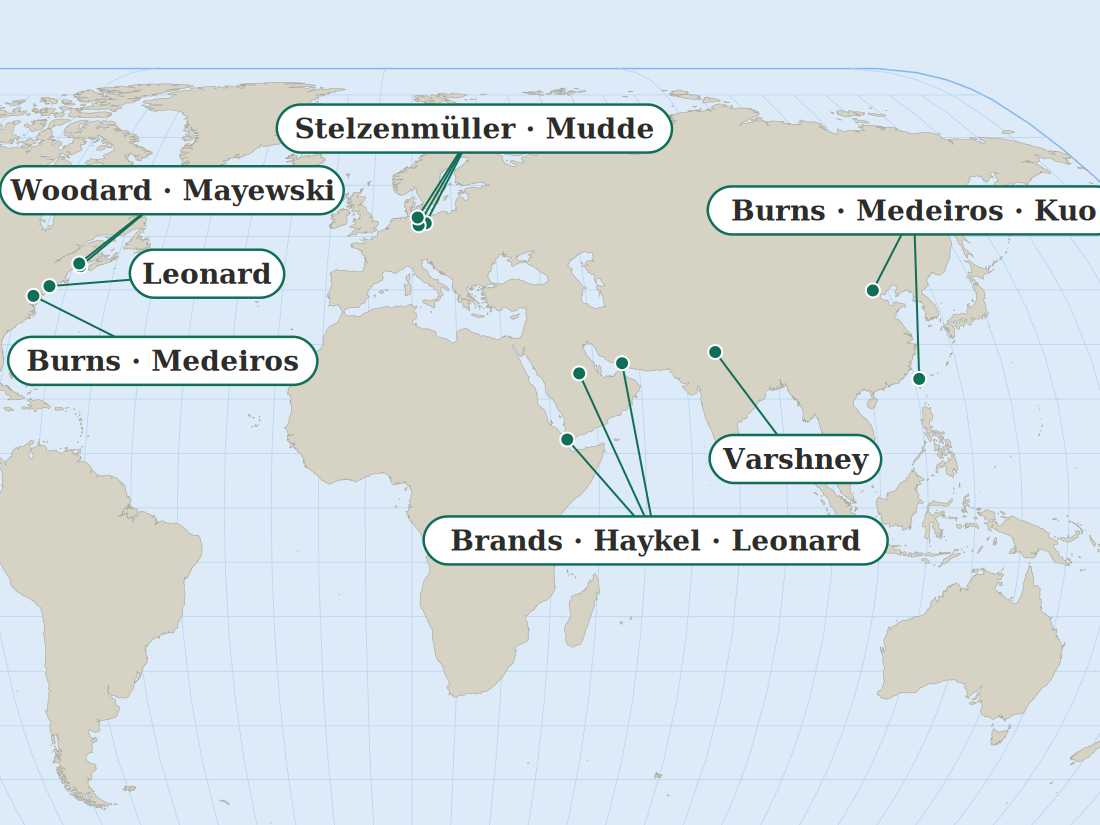
With our 40th anniversary Conference, CC27 Beyond the American Century: A New World Order?, just four months away, many of our past speakers spent September wrestling with the very questions we will take up in Camden this February.
As world leaders gathered in New York for the 81st UN General Assembly, Mark Leonard (CC22 Europe: Challenged at Home and Abroad), director of the European Council on Foreign Relations, argued that the international order is in worse shape than at any time since 1945 — and that no new order is waiting in the wings. In a Project Syndicate column, Leonard coins the term “un-order” for a world in which states act without reference to any common framework. His advice to Europe: stop behaving like architects defending old blueprints and start working like artisans alongside the middle powers, from Brazil and India to Qatar and Türkiye, that are improvising new forms of cooperation.
Hal Brands (CC25 Democracy Under Threat: A Global Perspective), the Johns Hopkins SAIS professor and Bloomberg columnist, likewise sees a world caught between a decaying American-led order and a successor that has yet to take shape. In a Bloomberg column, he uses Saudi Arabia as his case study: squeezed by the closure of the Strait of Hormuz, renewed Houthi attacks, and Washington’s refusal to intervene, the kingdom can no longer fully trust the U.S. — but there is no backup superpower to turn to. It is a dilemma, Brands warns, that American allies in Europe and East Asia increasingly share. He takes the argument further in “How to Survive in a World Without Rules,” (subscription) the cover essay of Foreign Policy’s Fall 2026 issue, which accepts that the dream of a rules-based order is fading into history and offers a survival guide for a world where raw power matters more than rules — one in which, he notes, Washington itself has at times tried to turn global public goods like shipping through Hormuz into protection rackets. Princeton’s Bernard Haykel (CC26 Today’s Middle East: Power, Politics & Players) was cited in coverage of Washington’s proposed $24.3 billion F-35 sale to Riyadh, saying the Saudis must now rethink their entire strategy after Saudi-backed forces lost control of the Bab el-Mandeb Strait to the Houthis, and will sooner or later have to pay off both Iran and the Houthis.
Chinese President Xi Jinping’s state visit to Washington drew sharp commentary from former U.S. Ambassador to China Nicholas Burns (CC09 Global Leadership and the U.S. Role in World Affairs; our moderator in 2010 and 2015). On PBS NewsHour, Burns called U.S.-China relations America’s most important and most dangerous relationship, but said the hardheaded, pragmatic Xi would not be swayed by the lavish welcome, and that Washington should be treating allies like Japan better than its adversaries — adding that Taiwan has reason to worry. The next morning on NPR’s Morning Edition, he faulted the President for being publicly uncritical of Xi, Vladimir Putin, and Kim Jong Un, and stressed that the U.S. needs Japan and South Korea at its side when dealing with Beijing. Georgetown’s Evan Medeiros (CC18 New World Disorder and America’s Future) weighed in on the same summit in a Financial Times op-ed (subscription) arguing that the case for talking to China is not a case for détente.
Kaiser Kuo (CC19 Is This China’s Century?), host of the Sinica Podcast, offered a different lens in a wide-ranging interview with Renewable Matter. Kuo notes that American views of China have softened markedly over the past year, especially among young people and Democrats, and argues that Beijing wants to reform global institutions rather than replace the U.S. as hegemon. Stable coexistence, he says, will require Washington to accept that there are paths to modernity without a Western face — while Europe could help steer the world toward a more multipolar, and possibly more stable, order.
Germany’s September state elections drew contrasting readings from two Camden Conference veterans. Writing for Brookings with Mathilda Silbiger, Constanze Stelzenmüller (CC15 Russia Resurgent and CC22 Europe: Challenged at Home and Abroad) warned that the far-right AfD’s first-ever state election victory in Saxony-Anhalt, the CDU’s historic collapse, and a Die Linke win in Berlin may together mark the end of postwar Germany’s stable, centrist political culture. In The Guardian, University of Georgia political scientist Cas Mudde (CC17 Refugees and Global Migration: Humanity’s Crisis) pushed back on the familiar “far right on the march” narrative, pointing out that voter frustration is fueling gains on the left as well — particularly among young women looking for liberal democratic alternatives to the established parties.
Nobel Peace laureate Maria Ressa (CC25 Democracy Under Threat: A Global Perspective), now co-chair of the UN’s scientific panel on artificial intelligence, told Foreign Policy’s Ravi Agrawal on the sidelines of the UN General Assembly that Big Tech is destroying democracy, and laid out how citizens can fight back. The conversation is free to hear on the FP Live podcast (and available in print for subscribers). Her warnings also anchor a widely syndicated World News Day essay by Spanish editor Fernando Belzunce, who argues that in an age of AI-driven misinformation, journalism’s great challenge is no longer just reporting the truth, but making it matter. Brown University’s Ashutosh Varshney (CC24 India: Rising Ambitions, Challenges at Home) turned to AI’s geopolitics in his ThePrint column, arguing that India, long a world leader in information technology, missed the AI boom through timid investment and a lack of foresight — and that as Washington and Beijing race for AI supremacy, how India balances AI’s power to replace workers against its power to empower them will be a political choice.
Closer to home, historian Colin Woodard (CC25 Democracy Under Threat: A Global Perspective) drew an overflow crowd to Acadia Senior College’s Clunan Lecture in Bar Harbor, where he asked what holds a country together when its regional cultures see the same nation so differently. His answer: a shared story Americans can believe in and see themselves in, rooted in the promise of the Declaration of Independence. And glaciologist Paul Mayewski (CC21 The Geopolitics of the Arctic: A Region in Peril), former director of UMaine’s Climate Change Institute, is leading a new NSF-funded University of Maine facility that will help scientists, fishermen, and communities track microplastics in Maine’s seafood, water, and soil.
A sneak peek at CC27: Georgetown’s Charles Kupchan, who will join us in Camden this February, answers Brands in the same Foreign Policy issue with “The World’s Only Real Hope of Maintaining Order.” Where Brands offers a survival guide, Kupchan calls for a new order, one that accepts the shift of power toward regional blocs while preserving a mechanism for global coordination, and he urges the policy community to start planning now for how to govern an interdependent world after Trump. Watch for more CC27 speaker announcements in the coming weeks.
Student Education Fund
Help ensure that future generations are informed and engaged on crucial global issues.